


The United States has long walked a fine line between being the world’s economic engine and its most indebted nation. Recent data from the Bureau of Economic Analysis (BEA) confirms that the U.S. net international investment position (NIIP) the difference between what Americans own abroad and what foreign entities own in the U.S. has reached a record negative level. Put simply, liabilities to foreign investors now dwarf U.S.-owned assets overseas, widening a liability gap that carries profound implications for global finance, geopolitics, and ordinary households.
This article explores not just the numbers, but their meaning. What does it signify when the world’s largest economy increasingly funds itself through foreign capital? Could this undermine U.S. power? And what ripple effects might nations like India or Middle Eastern oil exporters face as the American balance sheet tilts further into red ink?
The Numbers: Understanding the U.S. NIIP
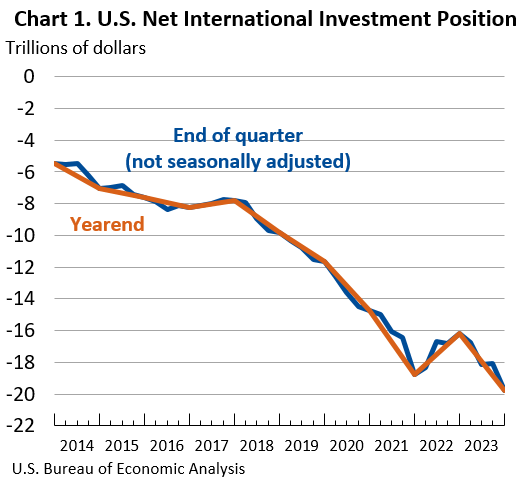
According to the BEA, as of mid-2025, the U.S. net international investment position stands at nearly -$20 trillion. This means foreign investors whether central banks, sovereign wealth funds, corporations, or private individuals hold roughly $20 trillion more in American assets than Americans hold abroad. To put this in context:
- In 2007, before the global financial crisis, the NIIP was closer to -$2 trillion.
- By 2014, it had slipped to around -$7 trillion.
- Today’s figure reflects a tenfold increase in less than two decades.
Breaking it down:
- U.S. assets abroad: Roughly $36 trillion (direct investment, securities, bank assets, reserves).
- Foreign assets in the U.S.: Over $56 trillion (Treasury bonds, corporate debt, real estate, equities).
This inversion highlights how foreign ownership of U.S. debt and equity has accelerated, reflecting America’s reliance on global capital inflows.
Why the Gap Matters: From Global Confidence to Vulnerability
1. Dollar Dominance as Cushion

The U.S. enjoys a unique advantage: the dollar is the world’s reserve currency. This allows Washington to borrow cheaply, as foreign central banks and investors are eager to hold Treasuries. Unlike smaller debtor nations, America doesn’t face sudden runs on its currency at least not yet. But over-dependence could eventually test the limits of confidence.
2. Interest Burden Rising
With U.S. interest rates elevated, the cost of servicing debt owed to foreign holders is ballooning. Every uptick in yields increases the income flowing overseas. For example, if average rates on U.S. liabilities rise by just 1%, the additional payments to foreign creditors could exceed $500 billion annually.
3. Strategic Risk Exposure

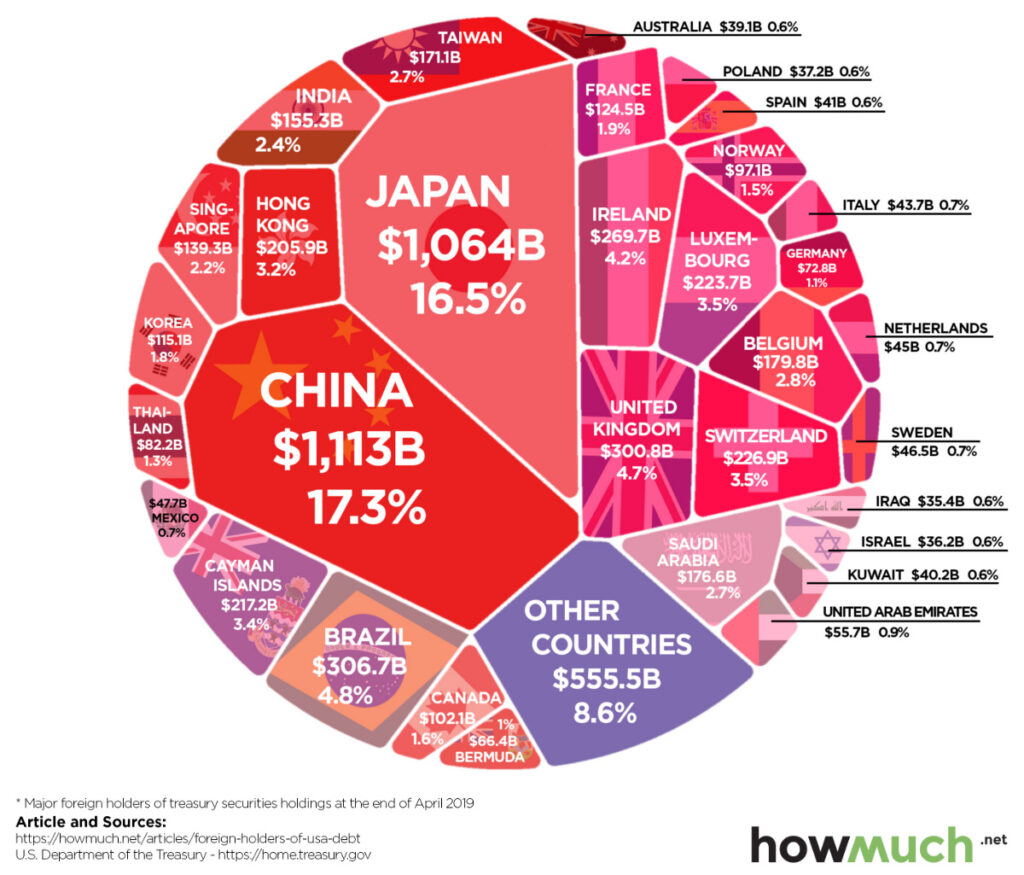
Heavy foreign ownership of U.S. debt introduces geopolitical leverage. Countries like China and Japan, which together hold over $2 trillion in Treasuries, could theoretically use financial positions as bargaining chips in diplomatic standoffs. Though they would harm themselves by destabilizing U.S. markets, the interdependence itself creates vulnerabilities.
4. Asset Imbalance
The U.S. increasingly owns foreign equities and direct investment, while foreigners overwhelmingly own U.S. bonds. That means the U.S. earns volatile returns (rising in booms, crashing in busts), while foreign investors earn relatively stable returns. In downturns, America’s NIIP can deteriorate even further.
Historical Comparisons: Learning from Past Deficits
America is not the first global hegemon to face such imbalances. In the late 19th century, Britain was the world’s top creditor nation, funding global infrastructure from Indian railways to African ports. By contrast, the U.S. in the 1980s began shifting from creditor to debtor. That transition was seen as manageable because of strong growth and technological leadership.
But today, the scale is unprecedented. No empire has ever carried such a large net liability while still maintaining global military supremacy. This raises a critical question: can the U.S. sustain its geopolitical dominance while being the largest net debtor in human history?
Global Consequences: India, Middle East, and Beyond
Impact on India
For India, America’s NIIP deficit is both an opportunity and a risk:
- Capital Inflows: A weak U.S. external position means America relies more on foreign investors, including Indian IT, pharma, and manufacturing companies expanding into the U.S. market.
- Rupee Volatility: If U.S. deficits spark dollar depreciation, the rupee could strengthen, hurting Indian exports.
- Bond Market Linkages: India holds modest U.S. securities; a sharp downturn in Treasury markets could affect India’s reserves and macroeconomic stability.
Impact on the Middle East

Middle Eastern states, especially Gulf oil exporters, are key financiers of U.S. deficits through sovereign wealth funds. Their returns on U.S. assets finance domestic development projects. Yet, if U.S. fiscal stress worsens, Gulf states risk exposure. This dynamic also shapes security alliances: U.S. military protection for Gulf monarchies is underpinned by financial interdependence.
Europe and Asia
- Europe’s pension funds remain major U.S. creditors, relying on stable dollar-denominated assets.
- Asia, particularly China and Japan, still bankroll U.S. consumption, but political tensions complicate this relationship. If U.S.-China rivalry escalates, financial decoupling could trigger global volatility.
Expert Views & Opinions
Economists are increasingly vocal:
- Carmen Reinhart (Harvard): “The sheer scale of America’s external liabilities suggests future crises may not look like sudden defaults, but rather gradual erosion of economic autonomy.”
- Eswar Prasad (Cornell): argues that the liability gap “tests the limits of dollar hegemony” and warns of a multipolar financial future if U.S. imbalances persist.
- Local Indian Perspective: Dr. Arvind Subramanian, former CEA of India, notes: “For India, a persistently indebted America is double-edged our exports thrive on U.S. demand, but our financial stability depends on how the U.S. manages its debts.”
Conclusion: America’s Balancing Test
The U.S. liability gap is more than just an accounting number. It reflects a profound transformation in global finance: the world’s superpower increasingly financed by the savings of others. While the dollar and U.S. markets still inspire confidence, history suggests that no imbalance can expand indefinitely without consequences.
For countries like India and Gulf states, America’s NIIP is not an abstract statistic it shapes trade flows, exchange rates, and even security partnerships. The coming years will test whether Washington can manage its debt diplomatically and fiscally, or whether a reckoning lies ahead.


Abhi Platia is a financial analyst and geopolitical columnist who writes on global trade, central banks, and energy markets. At GeoEconomic Times, he focuses on making complex economic and geopolitical shifts clear and relevant for readers, with insights connecting global events to India, Asia, and emerging markets.